There is a night each year when the old calendar says the door stands a little open. The harvest is in, the fields are bare, and the year tips from its bright half into its dark one. The Gaels called it Samhain — pronounced SOW-in — and it is the most quietly powerful turning on the Wheel of the Year.
You don’t need a coven, a cauldron or a shelf of supplies to keep it. You need a candle, a little time, and a willingness to sit with what the season is asking. Here is how to begin.
What is Samhain?
Samhain is an ancient Gaelic festival marking the end of the harvest and the beginning of winter. In the old reckoning, days began at sundown, so Samhain runs from the evening of 31 October to the evening of 1 November. (In the Southern Hemisphere, where the seasons are reversed, many practitioners keep it around 1 May instead.)
It was the Celtic new year: a threshold between one cycle and the next. And because thresholds are in-between places, Samhain was believed to be the night when the veil between the living and the dead grows thinnest — when ancestors might be remembered, spoken to, and invited home. Many of the customs we now call Halloween, from carved lanterns (originally turnips) to going door to door in disguise, have roots here.
What Samhain is asking of us
Every sabbat has a question. Samhain’s is this: What have I carried far enough? It is a festival of three things —
- Remembering — the people, places and versions of ourselves we have lost.
- Releasing — what we are not bringing into the dark half of the year.
- Resting — trusting that what goes quiet underground is not dead, only waiting.
Seven Samhain rituals for beginners
Choose one. Choose all seven. A ritual kept simply and sincerely is worth more than an elaborate one done for show.
1. Build an ancestor altar
Clear a small surface — a windowsill, the corner of a bookshelf. Add photographs of loved ones who have passed, or objects that belonged to them: a ring, a recipe card in their handwriting, a favourite teacup. Add a candle, something from the season (an apple, a sprig of rosemary, a few fallen leaves), and perhaps a small offering of what they loved to eat or drink. Light the candle on the evening of the 31st and say their names aloud.
If your family history is painful, you can honour chosen ancestors instead — teachers, writers, the women whose work made your life possible.
2. Set a place for the dead (the dumb supper)
An old custom: lay one extra place at the dinner table for those who have gone before. Some keep the whole meal in silence, the “dumb supper.” If silence feels like too much, eat as usual but serve the empty plate first, and let the conversation turn to stories about them.
3. A candle in the window
One of the simplest and loveliest traditions. Place a candle in a west-facing window at dusk — the direction of the setting sun, long associated with the realm of the dead — so that any soul travelling tonight can find its way. (A flameless candle keeps the spirit and loses the fire risk.)
4. The release ritual
On a slip of paper, write what you are finished carrying: a habit, a grudge, a fear, an old story about who you are. Read it once aloud. Then let it go — burn it safely in a fireproof dish or fireplace, bury it in the garden, or tear it into pieces and let it go out with the compost. Sit for a moment afterwards with the space it leaves.
5. Pull a Samhain tarot spread
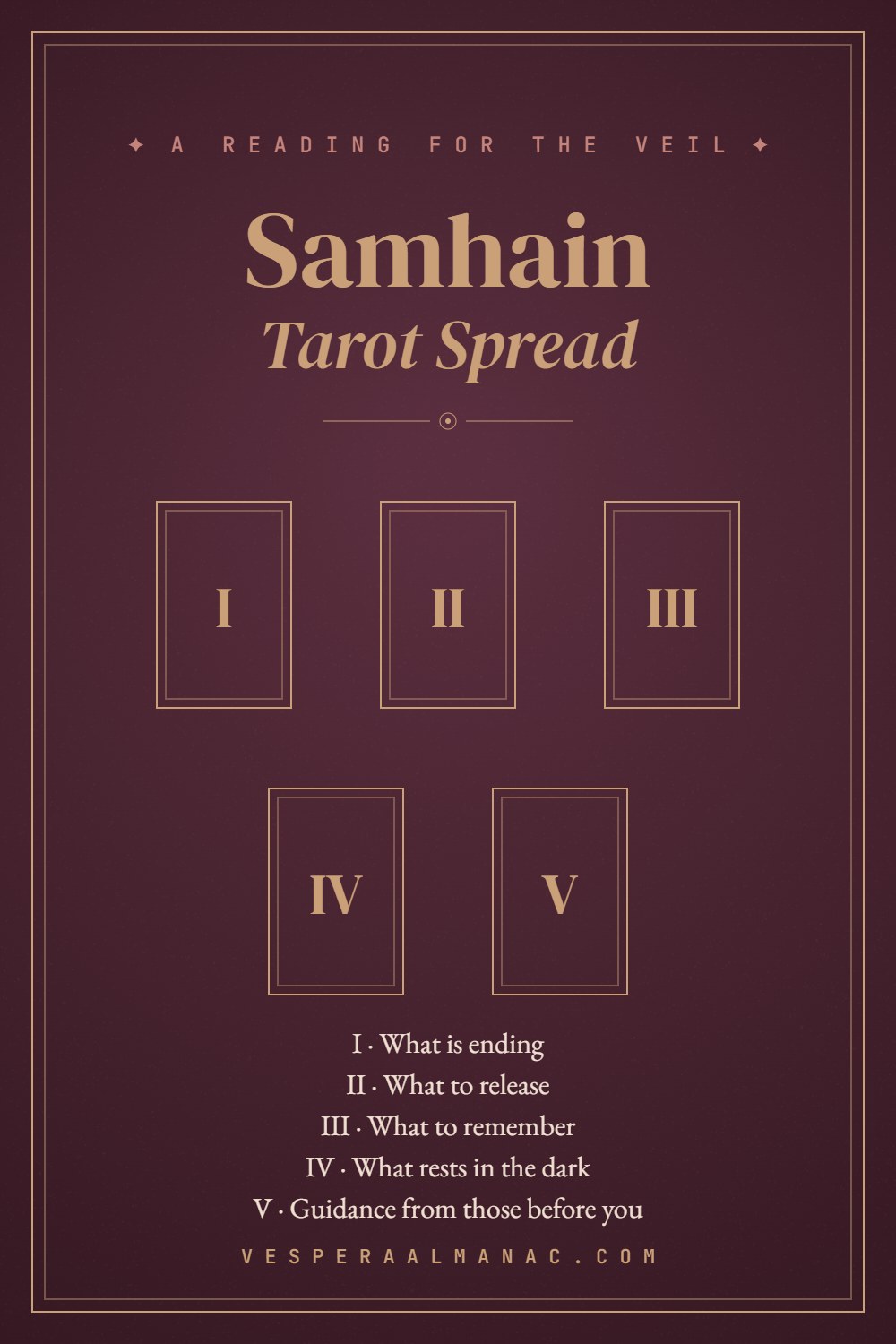
Divination has always belonged to this night. Shuffle, breathe, and lay out five cards:
- What is ending — the chapter closing with the year.
- What to release — what you can set down now.
- What to remember — a lesson or a person worth carrying forward.
- What rests in the dark — the seed you are not yet ready to see.
- Guidance from those before you — the ancestors’ word for the season ahead.
Write the cards down and revisit them at Yule. You may be surprised what the dark half made of them.
6. Apple divination
Apples are the fruit of Samhain. Cut one crosswise and you’ll find a five-pointed star in its core — an old symbol of protection. Eat it slowly while thinking of a question you’re carrying, or keep the traditional game: peel an apple in one long unbroken strip, toss it over your shoulder, and read the letter it forms on the floor.
7. Walk and clear
Take a slow walk at dusk and notice what the season is doing: what has fallen, what is holding on, what is already tucked away for spring. Come home and clear one small corner — a drawer, a desk, an inbox. Samhain is the old new year; it is a natural time to make room.
Samhain correspondences
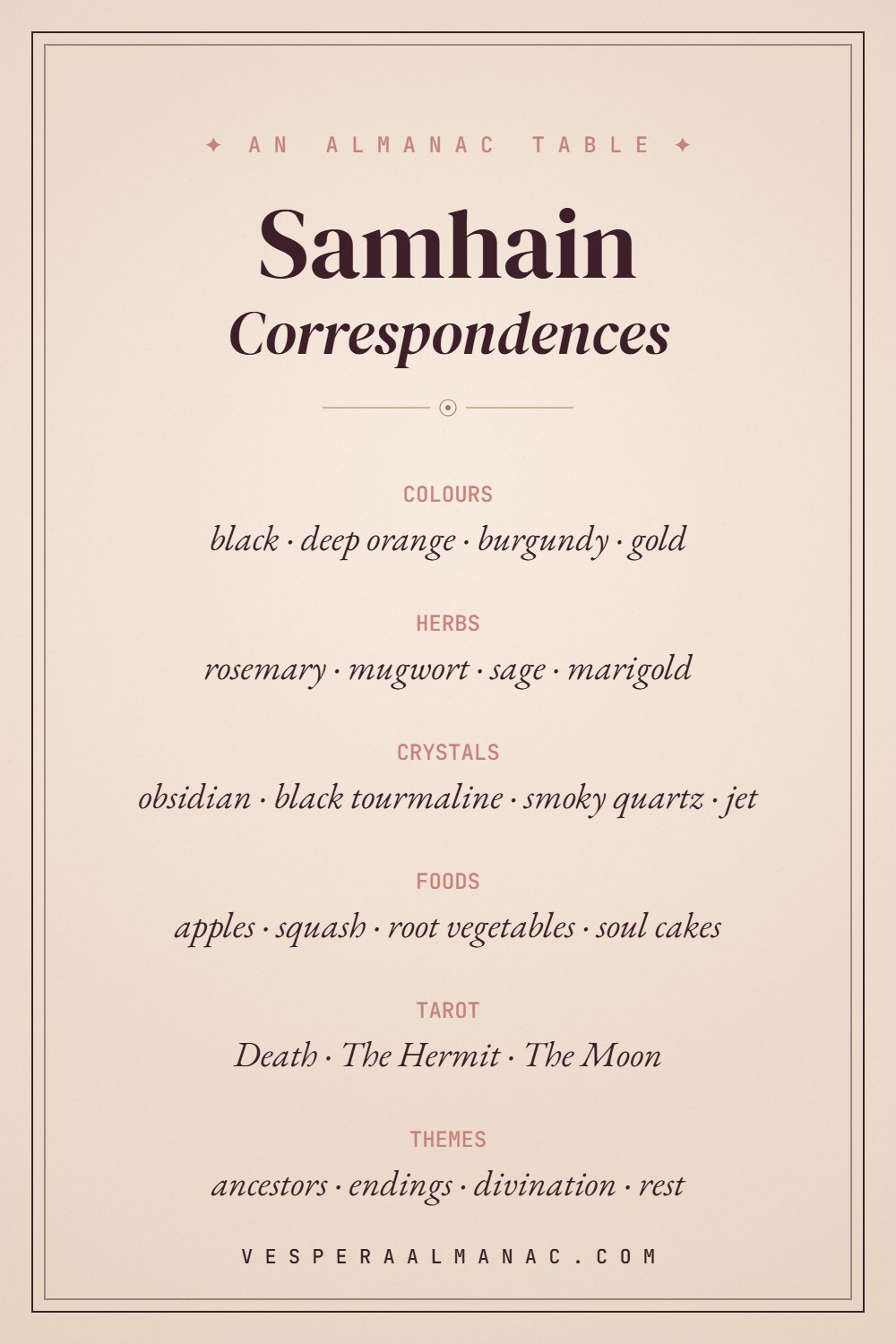
- Colours: black, deep orange, burgundy, gold
- Herbs & plants: rosemary (for remembrance), mugwort, sage, apple, pomegranate, marigold
- Crystals: obsidian, black tourmaline, smoky quartz, jet, carnelian
- Foods: apples, pumpkins and squash, root vegetables, bread, mulled cider, soul cakes
- Tarot: Death (endings and transformation), The Hermit (the inward turn), The Moon
- Themes: ancestors, endings, divination, protection, rest
The sky at Samhain 2026
This year the full moon rises on 25–26 October, just days before Samhain, and by the 31st the moon is waning — shrinking toward the new moon in November. Astrologically and seasonally, the timing could hardly be better: a waning moon is the classic window for releasing, clearing and letting go. If you only keep one ritual this year, make it the release.
What goes quiet underground is not dead. It is only waiting for the light to come back.
Frequently asked questions
Is Samhain the same as Halloween?
Not quite. Halloween grew out of Samhain (and later All Hallows’ Eve), and they share a date and many customs. But Samhain is a seasonal festival of the old calendar — about the harvest’s end, ancestors and the turning year — rather than costumes and sweets. You can happily keep both.
Do I need to be pagan or a witch to celebrate Samhain?
No. Remembering the dead, marking the season and pausing to reflect belong to everyone. Take what resonates and leave the rest.
What if I have no time on 31 October?
Keep it on the nearest quiet evening. The season is wide, and the intention matters more than the date on the clock.
Light a candle for us too. And if you’d like the week’s moon, one ritual and one question delivered every Sunday, join the Sunday Letter.